
Hawaiian Wedding Traditions and How to Honor Them
By the Hawaii Vendors team · 7 min read ·
What the lei exchange, a kahu’s blessing, the pū, the honi and hula mean at a Hawaiʻi wedding, and how visiting couples can include them with respect.
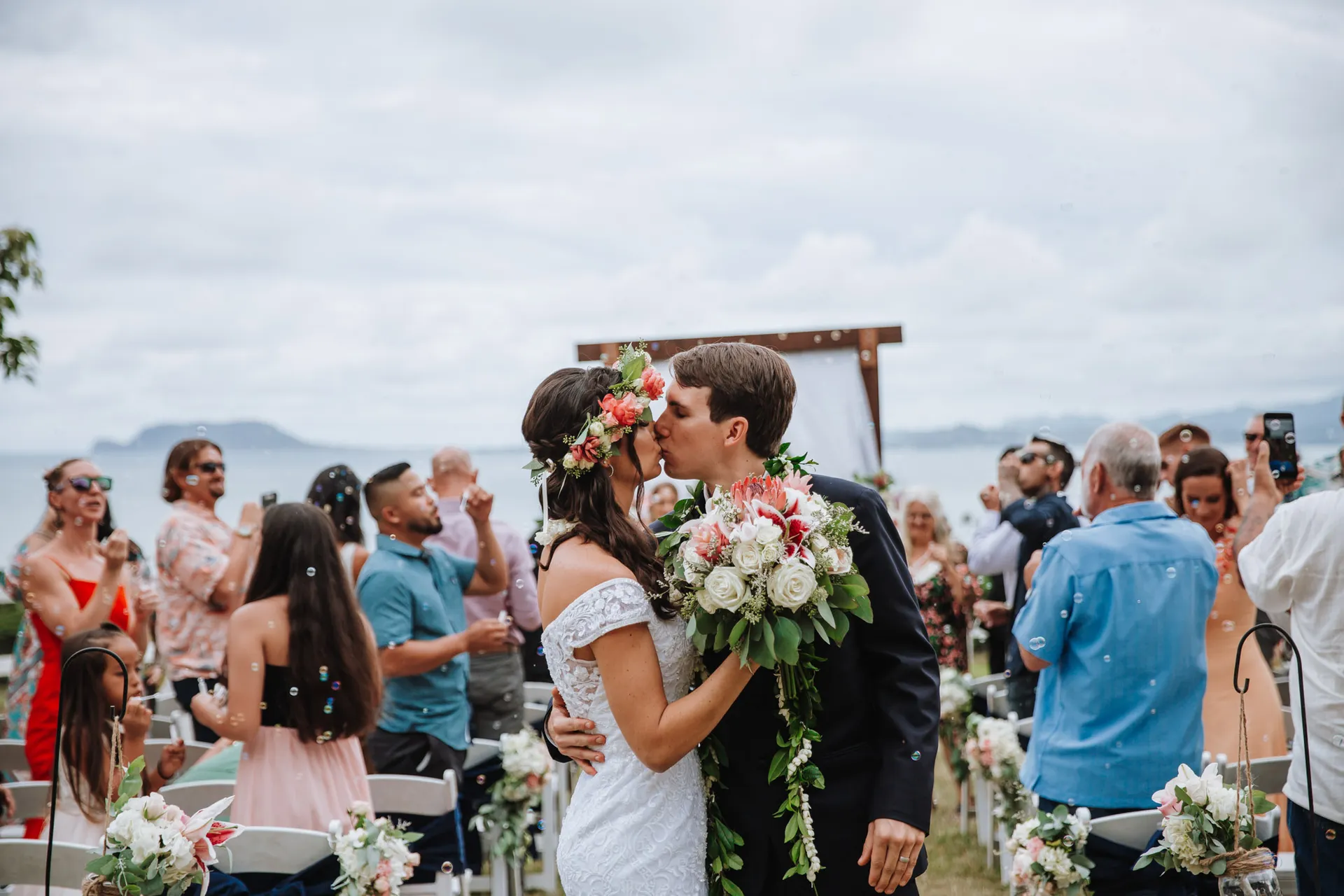
Most Hawaiian wedding traditions are easy for a visiting couple to take part in. You give and receive lei, a kahu offers a blessing, a conch shell sounds, and everyone gathers to eat. What takes more care is knowing where each custom comes from and who should lead it. This guide covers the customs you’re likely to meet at a wedding on Oʻahu or a neighbor island and how to include them with respect.
Customs vary by family and by practitioner, and laws can change. Check the details with your kahu and the sources linked below. Last checked October 2026.
What makes a wedding tradition Hawaiian?
Wedding customs in Hawaiʻi come from more than one place. The Hawaiʻi Tourism Authority’s Maʻemaʻe Toolkit, created with the Native Hawaiian Hospitality Association, describes local customs as Native Hawaiian traditions mixed with immigrant practices over generations. Some of what you’ll see has Native Hawaiian roots, some is local habit, and some is a newer wedding-industry offering.
The language shows the layers. In the Hawaiian dictionary by Mary Kawena Pukui and Samuel Elbert, the word for a wedding or marriage, male, is marked as borrowed from the English “marry.” The dictionary gives the older word for marriage as hoʻāo.
The toolkit also warns against calling cultural practices “ancient,” because the word implies they are no longer observed. “Traditional” fits practices with roots in the past that continue today. If a package promises an “ancient Hawaiian ceremony,” ask who leads it and where each part comes from.
What is the lei exchange, and which lei should you choose?
The dictionary defines a lei as a garland of flowers, leaves, shells, feathers or other materials, “given as a symbol of affection.” Lei are part of everyday life in Hawaiʻi. Many ceremonies include a lei exchange, in which the couple give each other a lei, and some couples also present lei to their parents.
Lei you may be offered:
Maile: A native twining shrub with glossy, fragrant leaves. The dictionary notes its use for lei on important occasions and its tie to Laka, goddess of the hula.
Pīkake: Arabian jasmine, with small, sweet-scented white flowers. It shares its name with the peacock because Princess Kaʻiulani was fond of both.
Lei poʻo: A lei worn on the head. Many people say “haku lei,” but haku is the technique: to braid a lei.
Orchid: The toolkit notes that many purple and white orchid lei sold in Hawaiʻi use imported materials, so ask your lei maker about Hawaiʻi-grown flowers if that matters to you.
Lei etiquette from the toolkit: treat a lei you’re given with respect, and if you must take it off, display it instead of dropping it in the trash or on the floor. In one tradition a pregnant woman does not wear a closed lei, so an open one is the considerate choice. The toolkit also discourages lei made from plants under threat, such as ʻōhiʻa lehua. And the plural of lei is lei.
Who is the kahu, and what are the pule and oli?
Kahu has many meanings in the dictionary, among them guardian, caretaker, and pastor or minister. At a wedding, the kahu officiates and blesses the marriage.
A pule is a prayer or blessing. An oli is a chant that is not danced to, often with long phrases carried on one breath. A kahu may open or close the ceremony with either.
These are religious and cultural practices, and they belong to the person offering them. Instead of handing your officiant a list of Hawaiian elements you found online, tell them about yourselves, ask what they would include and what each part means, and follow their lead.
One legal note: whoever performs your marriage must be licensed by the State of Hawaiʻi. Our Hawaii marriage license guide covers that step.
What are the pū and the honi?
The pū is a trumpet made from a large conch or helmet shell. Grinnell College’s musical instrument collection describes it as a signaling instrument, sounded in processions and to call people together, that still announces occasions such as the convening of the Hawaiʻi Legislature. At a wedding it often marks the start of the ceremony. Ask your kahu whether and when it belongs in yours.
The honi is a traditional Hawaiian greeting. The toolkit describes it as embracing and touching noses to share hā, the breath of life, and to show closeness. Some couples share a honi during the ceremony. Among guests, the contemporary greeting is a kiss on the cheek with an “aloha” and a hug.
How do hula and music fit into a wedding?
Hula is the traditional dance of Hawaiʻi, and its chants and songs carry history and culture. In the toolkit’s description, hula kahiko is performed to oli with percussion such as the ipu (gourd drum), as part of a ceremony or an extension of one. Hula ʻauana is less formal, with singing and stringed instruments such as guitar and ʻukulele.
At a reception you’re more likely to see hula ʻauana, and a relative or friend may dance for the couple. If you hire dancers, ask whether they come from a hālau hula (hula school). The toolkit notes that hula is often misrepresented with other Polynesian dances, so if a “Polynesian show” is offered, ask which parts are Hawaiian.
The song most tied to weddings here is “Ke Kali Nei Au,” known as the Hawaiian Wedding Song. Charles E. King wrote it in the 1920s as a duet for his operetta Prince of Hawaii, according to the Huapala Hawaiian music archive. The English version Elvis Presley sang in the film Blue Hawaii came decades later, with lyrics by Al Hoffman and Dick Manning that are not a translation of King’s Hawaiian words. If you want the original, ask your musicians whether they perform it in Hawaiian.
What about food, ʻohana and what to wear?
Gathering to share food with family and friends is at the center of local life. The Hawaiian term for a wedding feast or reception is ʻahaʻaina male. Lūʻau is a newer word than many people assume. According to the dictionary, it names the young taro tops served at a feast and has been used for the feast itself since at least 1856.
A local menu might include kālua pig (cooked in an imu, an underground oven), poi (made from kalo, or taro) and poke. The toolkit asks visitors to treat poi with respect, because of kalo’s place in Hawaiian genealogy. Try it, and skip the jokes. Our Oʻahu wedding catering guide covers service styles and what to ask a caterer.
ʻOhana means family or kin group, and it reaches wide. Children and locals often call people “auntie” or “uncle” as a sign of respect, related or not.
For clothes, aloha attire is a common way to dress up in Hawaiʻi. You may also see a holokū, which the dictionary describes as a loose dress with a yoke and usually a train, modeled on the dresses missionaries wore.
Which Hawaiian words are worth learning?
Aloha: love, affection and compassion, as well as a greeting.
Mahalo: thanks. Mahalo nui loa means thank you very much.
Hoʻomaikaʻi: to congratulate. Hoʻomaikaʻi ʻana means congratulations.
ʻOhana: family.
Kūpuna: grandparents and ancestors. The singular is kupuna.
Spelling matters. The ʻokina (ʻ) is a consonant, a glottal stop, and the kahakō is a line over a vowel that lengthens it. Leaving them out can change the meaning: the toolkit’s example is ono, a fish, and ʻono, delicious. Check spellings in the dictionary before you print invitations, signs or vows.
The toolkit also advises against shortening Hawaiian words and against wordplay built on them, so skip the “big kahuna” hashtag. And when it refers to people, “Hawaiian” means someone of Native Hawaiian descent. Other residents are locals or kamaʻāina.
How can visiting couples honor these traditions?
Hire Hawaiian practitioners and pay them. The toolkit asks that cultural practitioners be treated as the artisans and professionals they are and paid accordingly. That goes for your kahu, chanter, lei maker, musicians and dancers.
Ask before you add. Ask what a practice means, who should perform it, and whether it suits your ceremony. If the answer is that it doesn’t belong there, accept that.
Leave the land as you found it. Taking sand, dead coral, rocks or soil from the shoreline is prohibited by state law, apart from what clings to you and your things by accident. The toolkit adds that lava rocks and volcanic sand should stay where they are found.
Give cultural sites room. Not every heiau (a Hawaiian place of worship) is marked. The toolkit’s advice is to treat any unknown stone structure with respect and leave its stones alone.
Sand ceremonies and stone ceremonies are offered in many wedding packages today. If it matters to you whether a ritual is a Hawaiian practice, ask the person offering it where it comes from. For a sand ceremony, don’t fill the jars from the beach. Ask your planner or officiant to supply the sand.
A planner or venue that already works with Hawaiian practitioners can make introductions. Browse wedding planners, photographers, caterers, DJs and venues on Hawaii Vendors, or describe your wedding once through Get Quotes and ask each vendor how they work with a kahu.
Cover photo: Michele Coelho Photography. Hawaii Vendors features businesses that list with us.
Frequently asked questions
- What is a kahu at a Hawaiian wedding?
- Kahu is a Hawaiian word whose meanings include guardian, caretaker, and pastor or minister. At a wedding, the kahu officiates and blesses the marriage, and may offer a pule (prayer) or an oli (chant). Whoever performs your marriage must be licensed by the State of Hawaiʻi.
- What is a lei exchange at a Hawaii wedding?
- A lei is a garland given as a symbol of affection. In a lei exchange, the couple give each other a lei, and some couples also present lei to their parents. Maile, pīkake and lei poʻo (a lei worn on the head) are among the lei you may be offered. Treat any lei you receive with respect and keep it out of the trash.
- Is the Hawaiian Wedding Song a traditional Hawaiian song?
- The original, “Ke Kali Nei Au,” was written in the 1920s by Charles E. King as a duet for his operetta Prince of Hawaii. The English lyrics many visitors know were written decades later by Al Hoffman and Dick Manning and are not a translation of the Hawaiian words.
- Can we take sand or lava rocks home from our Hawaii wedding?
- No. State law prohibits taking sand, dead coral, rocks or soil from the shoreline, apart from what is carried away by accident, and the Hawaiʻi Tourism Authority’s Maʻemaʻe Toolkit says lava rocks and volcanic sand should stay where they are found.
- How can visitors include Hawaiian wedding traditions respectfully?
- Work with a kahu or Hawaiian cultural practitioner, ask what each practice means, follow their lead, and pay practitioners as professionals. Spell Hawaiian words with the ʻokina and kahakō, and avoid describing living practices as ancient.
Planning your own Hawaii wedding?
Browse vetted wedding vendors and venues across the Hawaiian islands.
Browse vendors